The first tumbler I ever pressed came out crooked, blistered along one seam, and headed straight for the trash can. I had measured twice. I had watched three videos. I still wrecked a perfectly good blank, and the worst part was that I could not tell you what I did wrong. What I eventually figured out is that most beginner tumbler failures are not talent problems. They are pressure problems. The press I started on clamped one flat spot and left the rest of the tumbler guessing. When I moved to a press built for drinkware, the crooked ones mostly stopped. That is the whole case for the HTVRONT Auto Tumbler Heat Press, and it is why I tell beginners to buy it before they buy anything fancier.
I have been pressing for about four years, out of the converted one-car garage of my house in Independence, Missouri. Team shirts for my grandson's baseball league got me started. Church groups and a couple of small local businesses kept me going, and tumblers came along the way most things do, through a neighbor asking if I could do twelve for a family reunion. I am not running a factory. I still babysit the fussy jobs. But the tumbler press is the one machine that made me feel competent in the first week instead of the first year, and that is worth more to a nervous beginner than any spec on a box.
The machine that stops the crooked tumbler problem at the source
Auto pressing, a 210 to 390 degree range, and a footprint small enough for a folding table. This is the one I would buy again as a beginner.
Amazon Check Today's Price on Amazon →10 Reasons the Tumbler Press Earns Its Space
It does the pressing so you can do something else
On my first setup I stood with both hands on a handle, counting in my head, and the second I looked away the pressure drifted. The HTVRONT press closes and holds while the heat works. You load the tumbler, click it shut, and walk off to bag a shirt order or answer a text. That sounds small. It is not. The mistakes beginners make are the ones made while bored and rushing, and this machine removes the boredom from the equation entirely.
Ten ounces to thirty ounces on the same machine
The press takes tumblers from 2.9 to 3.2 inches in diameter, and from 280ml to 850ml, which is roughly 10 to 30 ounces. That covers the skinny 20 ounce tumblers a school orders and the fat 30 ounce ones a hunting club wants, without you buying a second piece of equipment. When I was starting, I did not know what sizes people would ask for. Neither will you. Buying a range instead of a favorite size is the single most practical decision a beginner can make.
Pressure that goes around the tumbler instead of pinching one spot
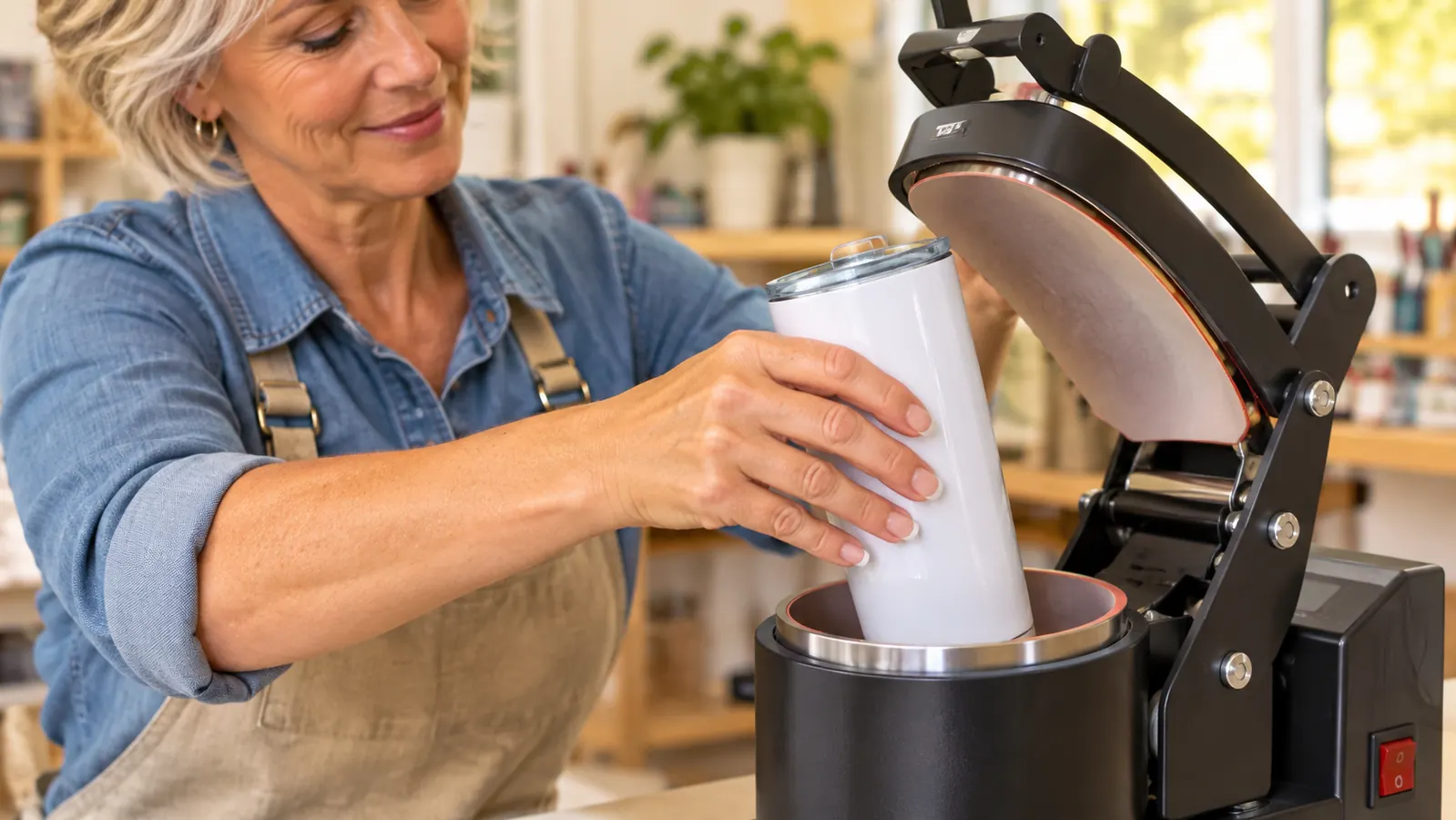
A flat platen pressing the side of a curved tumbler is a compromise, and you feel it in the results. The heat pad on this machine comes down along the body of the tumbler, so the pressure is spread rather than concentrated. Translate that into real life: fewer faded edges on the side that was facing away from you, fewer seams where the transfer lifted, fewer tumblers you quietly keep for yourself because you cannot sell them. My scrap rate dropped in the first month and it never went back up.
The R button is the undo key beginners need
Press the R button and the machine halts heating and releases the heat pad instantly. I want you to read that twice, because if you have ever smelled a tumbler starting to scorch and had to fight a hot clamp open with your hands, you know exactly what this is worth. Sublimation goes wrong fast. Being able to stop it in a second instead of a minute is the difference between a blank you can redo and one you throw away.
A temperature window wide enough for the work you will actually do
The machine runs from 210 to 390 degrees Fahrenheit. Most drinkware sublimation lands comfortably inside that window, and having room on both ends means you are not maxing out the machine on every job or guessing at the bottom of its range. Beginners tend to think a wider range is a professional feature. It is really a beginner feature, because you will be adjusting temperatures constantly in your first months while you learn what your blanks and your paper want.
It handles mugs, bottles and glasses too, not just tumblers
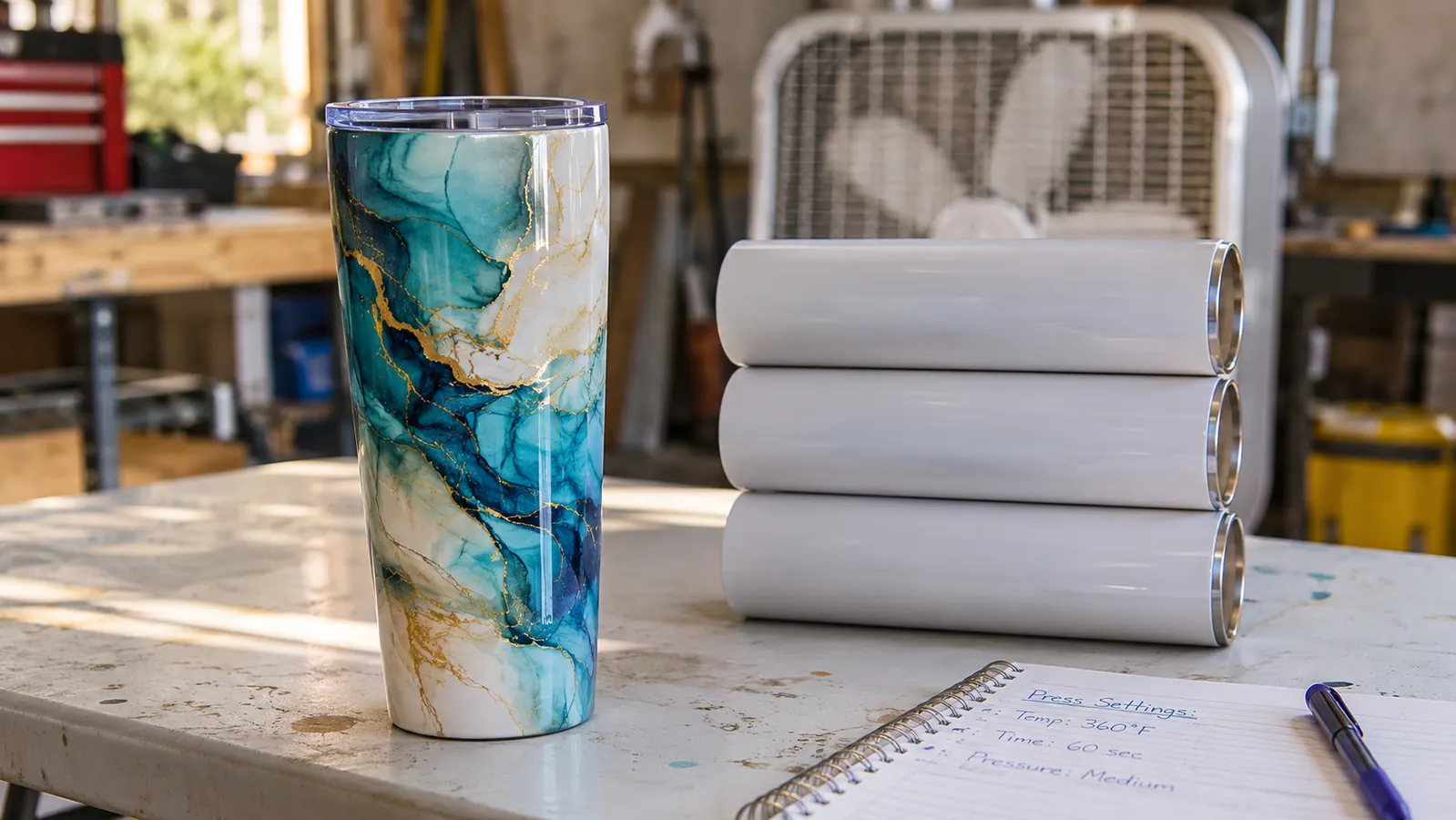
The listing recommends it for sublimation on drinkware including tumblers, mugs, water bottles and similar items, and the title names glasses. That matters more than it sounds. Church groups order mugs. Kids want water bottles with their name on them. A wedding party wants glassware. If your only machine does one shape, you turn down work without meaning to. One press that covers the drinkware people actually ask for keeps you saying yes while you are still figuring out what you enjoy making.
Small enough for a corner of a one-car garage
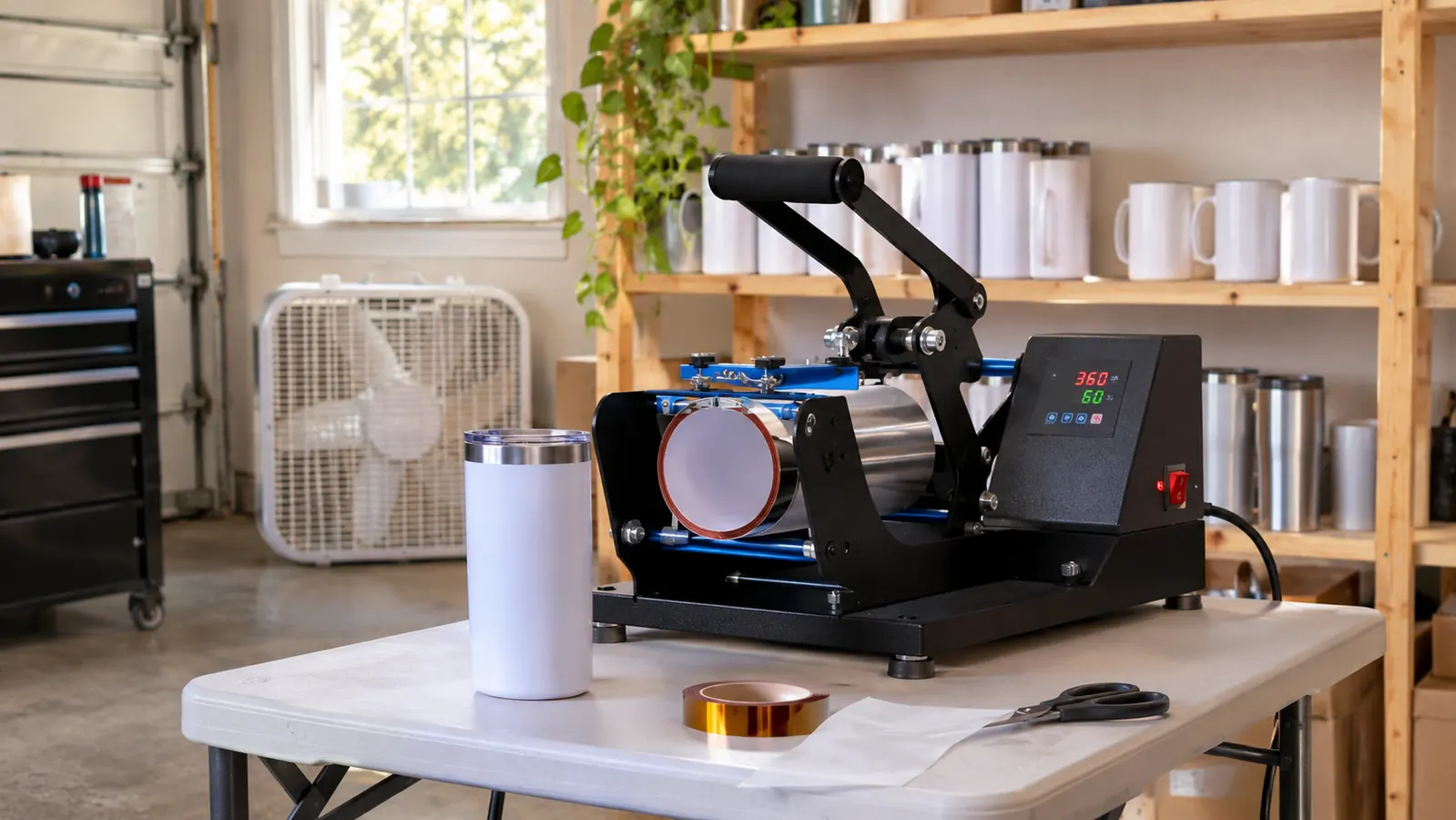
It measures 12.9 inches long, 10.9 inches wide and 6.3 inches high, and it weighs 9.5 pounds. My whole workspace is one long folding table, a shelf of blanks, and a box fan I run in summer. This press does not ask for more room than that. If your setup is a corner of a garage, a spare bedroom, or a dining table you clear off on weekends, you can leave this sitting out and still have space to fold shirts next to it.
Six hundred watts is kind to old garage wiring
At 120 volts and 600 watts, this is not a machine that demands a dedicated circuit. My garage is not modern, and I have tripped a breaker with a space heater before. The press has never been the thing that did it. For a beginner working out of a house rather than a shop, that is a genuinely useful detail, because the alternative is running an extension cord across the floor and hoping, which is how people end up with a dead outlet and a half-finished order.
A one year warranty covers the part most likely to go wrong
The warranty is one year. That is not remarkable on its own. What makes it matter is which part tends to fail on a tumbler press: the heat pad and the mechanism that moves it. Those are exactly the pieces you cannot fix with a screwdriver and a video. Two thousand four hundred and fifty reviews at 4.5 stars is not proof of anything, but it does mean the failures are not happening in a flood, and a year is enough time for a flawed unit to show itself.
You can say yes to a team order without losing a weekend
Twenty four tumblers for a school fundraiser used to mean twenty four rounds of standing over a clamp and counting. With the press holding each one on its own, the job becomes loading, unloading, and letting the finished ones cool in a row on the table. I am not going to tell you what that turns into money wise, because I do not know your town or your prices. I will tell you it turns a job you dread into a job you can start on a Friday evening and still have a Saturday.
What I'd Skip
I would skip the enormous multi station presses that show up in videos of big shops. They are built for volume you do not have yet, and they eat the table space you do have. I would skip the cheapest no name tumbler press on the marketplace, because the heat pad is the part that fails and the anonymous ones have no one to call. And I would skip buying forty blanks before you have pressed five. Buy three tumblers, press them badly, learn what your paper and your temperature want, then order the case. The other thing worth skipping is the idea that the press will fix a bad design. It will not. A muddy print comes out as a permanent muddy print, just with better edges.
My scrap rate dropped in the first month and it never went back up.
Start with the machine, not the inventory
Buy three blanks, learn the press, then order the case. The HTVRONT Auto Tumbler Heat Press handles 10 to 30 ounce drinkware and stops heating the second you hit R.
Amazon Check Today's Price on Amazon →