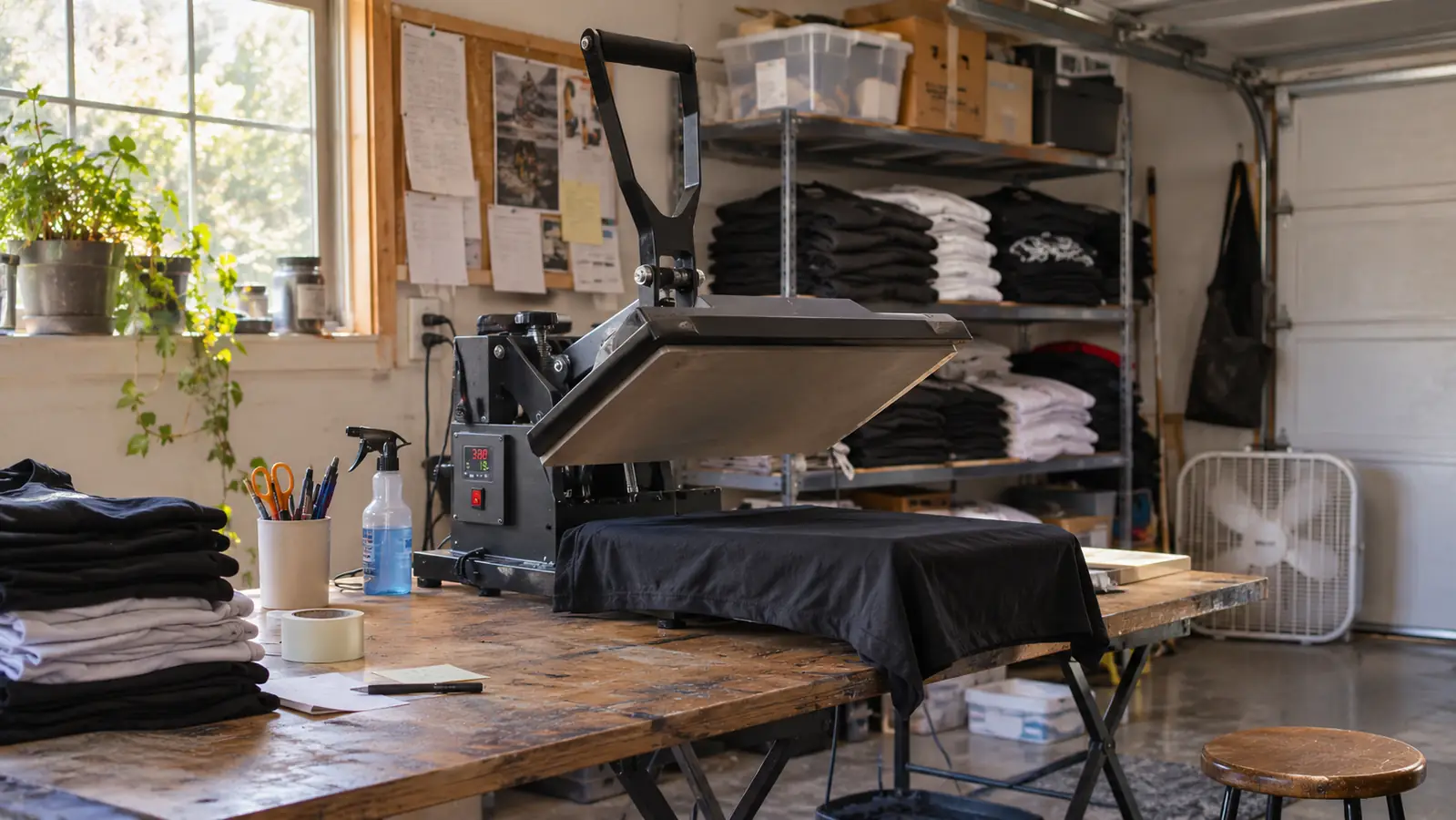
I bought the Fancierstudio 15x15 heat press for one unglamorous reason. A 12 inch platen could not hold a full back print on an adult 3XL shirt without two passes and a seam down the middle. My grandson's baseball league had just ordered 22 team shirts, and the smaller press I started on turned that job into an afternoon of lining up edges and pressing the same shirt twice. The Fancierstudio went onto the folding table in my garage the week it arrived and it has not come off since.
I have been heat pressing for about four years. Mostly team shirts, church group orders, family reunion shirts, and a few totes and mouse pads for small local businesses. I am not a print shop and I am not going to pretend a machine turned me into one. I am a 52 year old former school office manager in Independence, Missouri, working out of a converted one car garage with a shelf of blanks, one long table, and a box fan that runs all summer. So this is not a spec sheet read aloud. It is what the press has actually done for me over months of steady orders, and where it has annoyed me.
The Quick Verdict
A plain, hardworking 15 by 15 press that does a full adult back print in one pass and holds its setting. The three month warranty is the real tradeoff, and you should plan on replacing the pressing pad eventually.
Amazon Check Today's Price →If a 12 inch platen is already costing you shirts, this is the upgrade
Fancierstudio 15x15, 1800 watts on a standard 110 volt outlet, electronic heat and time control, Teflon coated platen. Check the current price and the full listing on Amazon before you decide.
Amazon Check Today's Price on Amazon →How I've Used It
Setup took about fifteen minutes. The press needs a 110 volt outlet, and at 1800 watts it pulls enough that I stopped sharing a power strip with the shop light and the fan. If your garage wiring is older than you are, give this thing its own outlet and save yourself the flicker. After that it is a machine you switch on, set, and use. There is nothing to install, nothing to pair, nothing to download, and no app to fight with on a Saturday morning when you have 40 shirts to get through.
The footprint matters more than I expected. The listing gives the dimensions as 33 inches long, 23 inches wide and 20 inches high. On my table that leaves room for a stack of blanks on one side and a teflon sheet and lint roller on the other, and that is about it. If your plan is to set this up on the kitchen counter and put it away every night, measure first and be honest with yourself about whether you will actually do that. A press that lives in a closet does not get used.
Heating from cold to 350 F takes me roughly six or seven minutes. I turn it on, go fold whatever came off the last batch, and come back to it. The heat and the time are both set electronically, which is the part I care about most. My first press had a mechanical dial you nudged and hoped. This one you set a number and it holds that number while you work through a stack. The listing puts the range at 0 to 699 F, with a time range of 0 to 999 seconds.
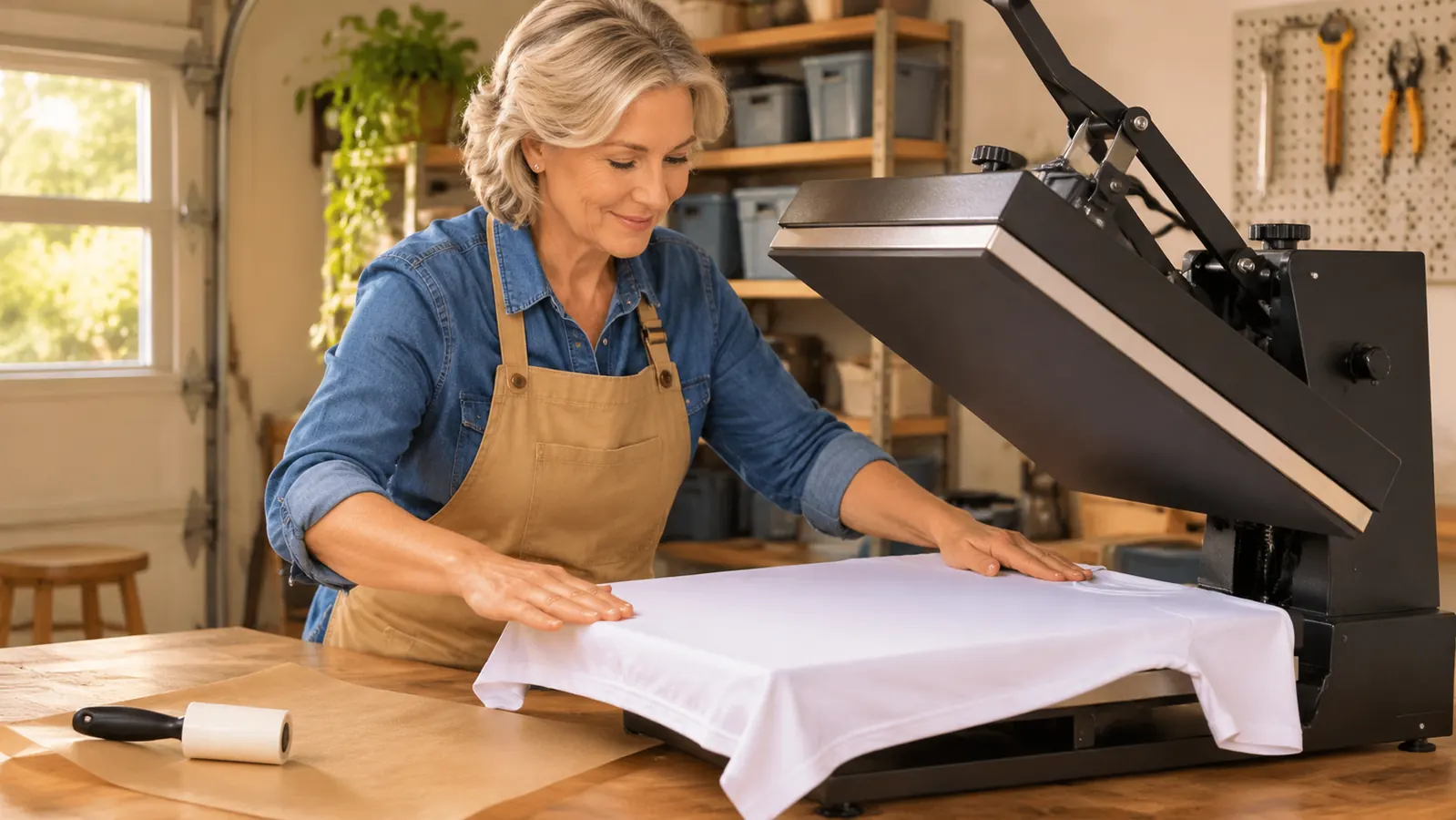
What I run through it: adult back prints, adult front prints, youth shirts, tote bags laid flat, mouse pads, and the occasional koozie run lined up four across. The listing names bags, mouse pads and t-shirts as the recommended uses, and that lines up with my experience. The 15 by 15 inch platen is the reason. One press, one pull, one shirt, no seam.
What the Specs Mean Once It Is Sitting in Your Garage
1800 watts and 110 volts is a household circuit, not a dryer plug. That is the good news. The less good news is that 1800 watts is real draw, and anything else on that circuit will notice. I learned this the ordinary way, by tripping a breaker mid press on a busy Saturday with Gary waiting to fold. Now the press has its own outlet and everything else in the garage is somewhere else.
The temperature range is listed as 0 to 699 F, and the same listing also carries an upper temperature rating of 500 F. Those two numbers sit in the same listing and they do not agree, which is exactly the kind of thing that makes a beginner nervous. Here is what it means in practice. You will spend almost all your time between 300 and 400 F. Sublimation work runs hotter than vinyl work. I have never needed anything close to the top of that range and I would not push a machine up there on purpose.
The time range runs 0 to 999 seconds, which is far more than any shirt needs. A vinyl press is usually somewhere between 10 and 20 seconds. Sublimation runs longer. What matters is that the control is electronic and the setting holds between shirts. What I will say honestly is that I still count in my head on a big order, because a second or two of drift across a 40 shirt run shows up later as a shirt that peels early. Whether that is the machine or my attention span, I cannot prove. Counting costs nothing.
The platen has a Teflon coating and a 15 by 15 inch heat press sheet comes in the box. The coating is the difference between a clean press and a scrubbing session next to a shirt you just ruined. It also means you can press directly on some materials without a cover sheet, though I still use one for anything with a transfer already on it. The included sheet is a starter sheet. Order a spare the same week you order the press.
Where the Press Fights You
The three month warranty is the number I would point at if a friend asked me about this press. Three months is short. It covers the machine through the learning curve where you are most likely to break something, and then it stops. That is not a reason to skip it. It is a reason to open the box the day it lands, run it hard, and get your mistakes out of the way while there is still coverage instead of letting it sit until spring.
Pressure is the thing nobody explains well, and it is not a number you can set. You feel it. Too little and the transfer sits on top of the fabric and peels off in the wash. Too much and you get a hard, flat, shiny print with a visible platen edge. My rule now is to press a scrap of the exact fabric I am about to sell, peel a corner while it is still warm, and adjust before I touch a real shirt. That one habit saved more blanks than any setting on the panel.
The listing gives the material as rubber, and that fits what I feel when I press: a surface with some give under the shirt rather than bare metal. That give is what you want, because it is what lets a print sit evenly across a big back panel. It also means the pressing surface takes all the abuse and will eventually need replacing. Mine has a slight dip in the middle after months of work, and that dip shows up as a pale patch on large prints. A replacement pad is a small fix I should have made sooner.
What I Ruined Before I Learned
The first thing I ruined was a set of six youth shirts for a church group. I had the temperature too high, the pressure too heavy, and the blank was a polyester blend that wanted neither. Every print came out shiny with a scorch ring around the edge. I replaced that order myself, which is a lesson that sticks in a way a blog post never does. Now I keep a scrap bag of the actual blanks I sell, not a generic test cloth, and I test on the real thing every time I open a new box of shirts.
The second thing I ruined was a sublimation project. Sublimation wants consistent pressure across the whole surface and it punishes a worn pad without mercy. On a large print I could see the pale patch where the pressure dropped off. That is what sent me looking at the pad in the first place. If sublimation is part of your plan with this press, start with a fresh pad, keep your blanks flat, and store them somewhere they will not warp before you press them.
The third one was not the press at all. It was me, in a hurry, pressing a shirt with a wrinkle in it. A wrinkle becomes a crack in the transfer, every single time, and no amount of re-pressing fixes it cleanly. Twenty seconds with a lint roller and a quick pre press saves the shirt. That is the least technical advice in this whole article and it is the advice I use most.
The 15x15 Platen Versus Everything Smaller
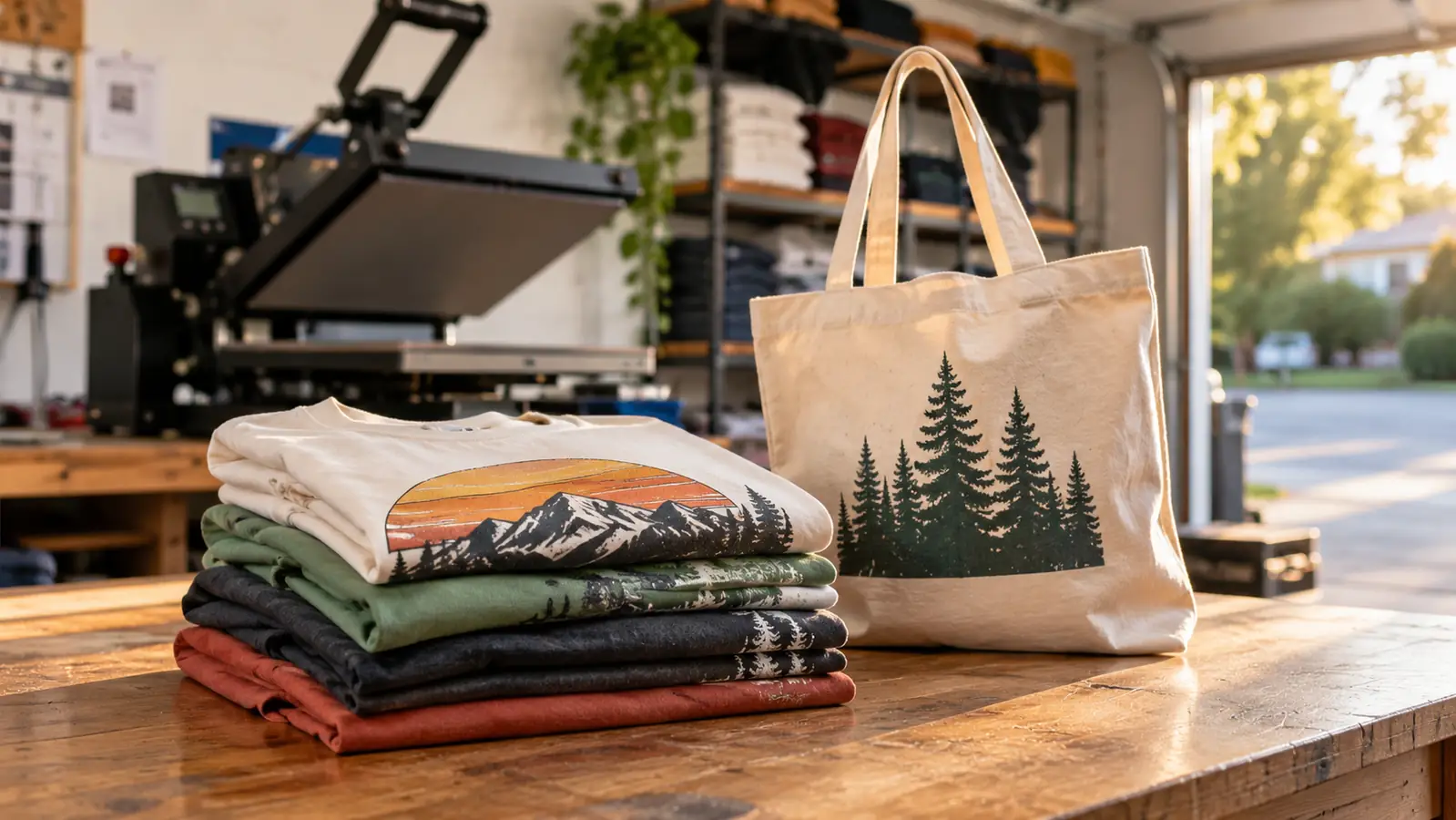
The math on platen size is simple and it is the reason people move up. A 12 inch platen covers a child's shirt front all day long. It covers an adult medium front. It does not cover an adult back. Two passes on a back print means a seam, and a seam means a customer who notices. If your orders are team shirts and reunion shirts, your customers are adults, and adult backs are bigger than 12 inches.
The other side of that is small work. Koozies and mouse pads on a 15 by 15 platen mean you are heating a lot of empty space. I line up four small items and press them together, which works fine, but it takes a little planning and a teflon sheet to hold everything flat. There is nothing wrong with that. It just is not as quick as a small dedicated press for tiny items, and pretending otherwise would be silly.
There is a longer comparison on this site about how a 15 by 15 press stacks up against a craft style press, and a separate piece on why a press beats a hand iron for anything bigger than a onesie. Both come down to the same thing. Even heat and even pressure across the whole print, once, with nobody sliding an iron around and hoping. A hand iron gives you neither and it shows on the second wash.
What I Liked
- Full adult back print in one pass, no seam down the middle
- Electronic heat and time control holds a setting through a whole stack
- Teflon coated platen, and a 15 by 15 inch sheet comes in the box
- Runs on a standard 110 volt household outlet at 1800 watts
- Simple enough to be pressing real shirts the same afternoon
Where It Falls Short
- Three month warranty is short and ends right after the learning curve
- 33 by 23 by 20 inches claims a permanent chunk of table
- Pressure is set by feel, not by a number on the panel
- The pressing pad develops a dip and eventually needs replacing
- I still count in my head on large runs instead of trusting the timer alone
Six or seven minutes to 350 F. Fifteen seconds a shirt. Forty shirts in a row without touching the setting again. That is what I actually pay a press to do.
Who This Is For
This is for the person who bought a small press, or is about to, and keeps getting orders that are bigger than the platen. If your customers are schools, churches, teams, reunions, or small businesses that want their name on a back, the 15 by 15 size is the difference between doing the job and explaining why the shirt has a line through it. It is also for the beginner who wants one machine on one table, set by number, that does not need an app or a wireless connection or a manual the size of a phone book.
It suits someone with a dedicated corner. A garage, a spare room, a basement, anywhere the press can sit at working height and stay put. Fancierstudio made a plain machine here, and plain is a compliment. I never once had to troubleshoot it at 9 pm the night before a delivery, which is more than I can say for some equipment in this house.
Who Should Skip It
Skip it if you only ever press onesies, baby shirts, small left chest logos, and napkins. You are paying for 15 inches of platen and 1800 watts of draw, and you will spend most of your time heating empty air. A smaller press would be easier to store and easier to set up on a counter you clear every night.
Skip it too if a three month warranty is a dealbreaker for you. That is a fair position to take, and I would rather say it plainly than talk you into something that keeps you up at night. And skip it if you cannot give it its own outlet and a permanent surface. A press this size, unplugged and folded away between jobs, is a press that will not earn its space, and that is true of every brand in this category, not just this one.
Measure your table, then measure your biggest order
If the answer is an adult back print in one pass, the Fancierstudio 15x15 does that job with electronic heat and time control on a standard outlet. Check today's price and the current listing details on Amazon.
Amazon Check Today's Price on Amazon →