I bought the HTVRONT Auto Tumbler Heat Press in March, three years into a small custom shirt, tote and mug business that runs out of the converted one-car garage behind my house in Independence, Missouri. Before it, every tumbler I sold went through a mug attachment clamped onto a flat press. That setup worked, but it kept me standing at the table for the whole press, one tumbler at a time, because the wrap would cool unevenly the second I walked to the shelf for the next blank.
The HTVRONT takes over the part I dreaded. It wraps the heat pad around the full circumference, holds its own pressure, and lets go when I tell it to. Since March it has gone through school spirit orders, church fundraiser tumblers and a family reunion batch of sixty, and it has not once quit mid-press. Here is what months of that actually looks like, including the parts that annoyed me.
The Quick Verdict
A hands-off tumbler press that holds its own pressure and fits 10 to 30 ounce drinkware. It will not fix a wrinkled wrap, but it freed my hands and made long orders bearable.
Amazon Check Today's Price →Press one tumbler while the next one is already wrapped
The HTVRONT Auto Tumbler Heat Press holds its own pressure so your hands are free for the next blank. Fits drinkware from 10 to 30 ounces and 2.9 to 3.2 inches across.
Amazon Check Today's Price on Amazon →How I've Used It
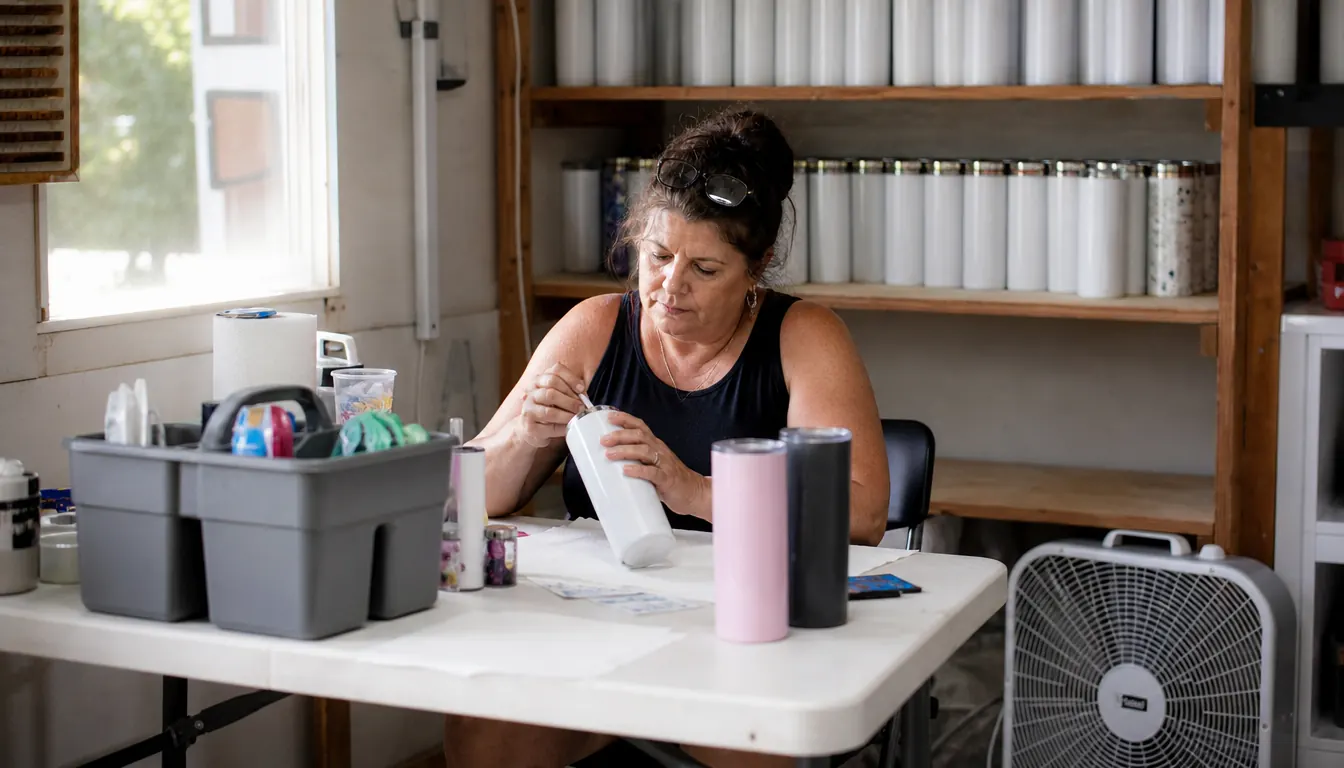
My whole workspace is one long folding table in the garage. The press sits on the left, the shelf of blanks sits on the right at eye level, and in summer I run a box fan on the floor because a heat press in a garage in July is a second job. I kept the HTVRONT there because it measures about 12.9 inches by 10.9 inches and stands 6.3 inches tall, so it does not eat the entire surface the way my flat press did. It weighs 9.5 pounds, which means I can pull it to the middle of the table for a big batch and push it back against the wall when I am done.
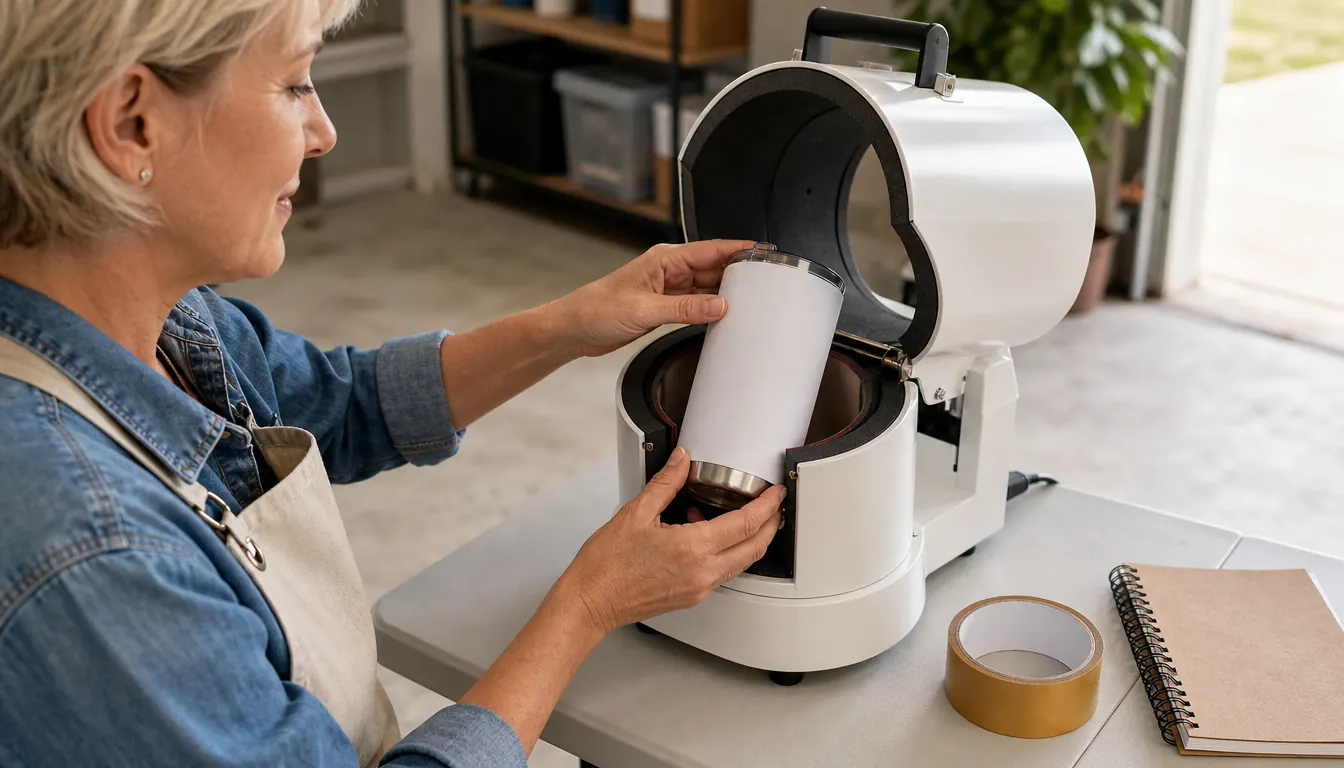
The routine has not changed much, only who does the holding. I wipe the blank down, wrap the sublimation paper, tape the seam and slide the tumbler into the press. Then I set the temperature, press the button and walk away. Most of my drinkware work runs between 350 and 380 degrees, and the machine covers 210 to 390, so I have never run out of range at either end. While the first one presses, I wrap the second. That is the whole change, and it is the reason I kept it.
On busy weekends my husband Gary folds and bags while I load and unload, and the table keeps moving without either of us standing over a clamp. I press shirts, totes and mugs for local teams, a church group and two small businesses that order every few months. The tumbler orders were the ones that used to make me turn work down. I do not turn them down now.
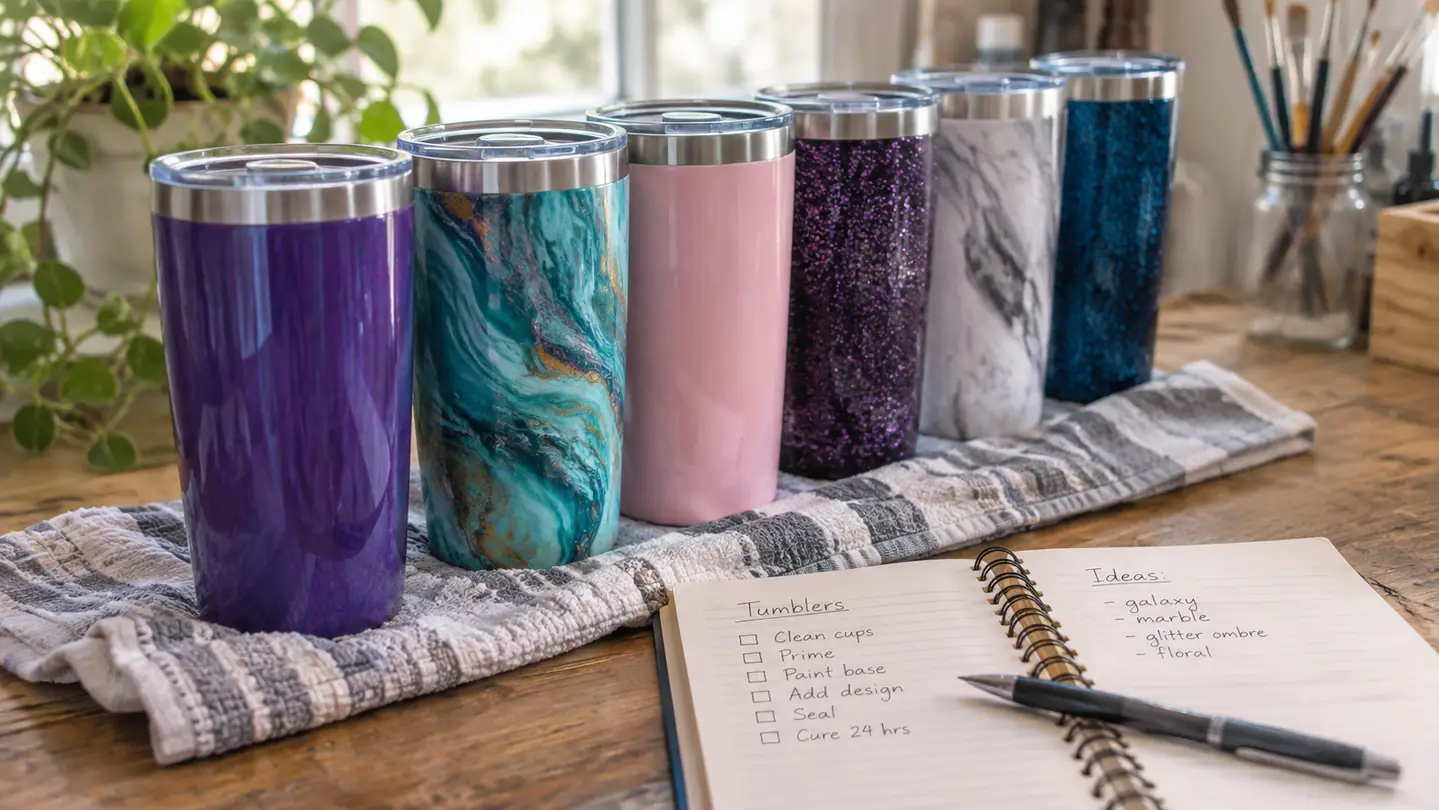
One Saturday in April I had a church fundraiser order for forty tumblers, all 20 ounce, all the same design. I started at seven in the morning with the fan already running. I wrapped in lots of ten, pressed them in order, and set each finished one on a dish towel to cool before I peeled the paper. By ten thirty I was done and the table was clear. On my old clamp setup that same order had taken me most of a day and left my shoulders sore. The difference was not that the machine presses faster. It is that I was never stuck standing in one spot waiting.
What the Auto Press Does That My Old Setup Did Not
With a manual setup, you are the pressure. You clamp, you stand there, and you second-guess whether the wrap is drifting the whole time. The HTVRONT closes around the tumbler and holds it, so the pressure at minute one is the pressure at minute ten. That consistency shows up in the finished piece. The fortieth tumbler in a batch looks like the first one, which was never true when I was pressing by hand and getting tired around number twenty.
The R button is the feature I did not know I needed. It halts the heating and releases the heat pad instantly. When a seam starts to lift or a wrap slides in the first few seconds, that instant release is the difference between a tumbler I can save and one that goes in the scrap bin. On my old setup I would be reaching for a clamp while the wrap kept cooking. I have saved maybe a dozen blanks this way, and blanks are not free.
Power is simple but worth planning for. It pulls 600 watts on 120 volts. In my garage that is fine on its own circuit, but in winter I do not run the space heater on the same line while a batch is going. The shell is ABS, the temperature tops out at 390 degrees, and the unit carries a one year warranty. I have not had to use it.
The Size Range, Which Blanks Fit, and Which Do Not
The press takes tumblers from 2.9 inches to 3.2 inches in diameter and from 280 milliliters to 850 milliliters, which is 10 to 30 ounces. That covers the standard drinkware most of my customers ask for: the 20 ounce tumbler a teacher wants, the 30 ounce one a team parent orders, the 12 ounce cup for a birthday party.
What it does not cover matters just as much. Anything outside that window will not seat properly. Wide can style cups, slim water bottles and tapered tumblers that narrow at the base are all out. If you buy blanks from a supplier you have not used before, measure the diameter before you order a case. I learned that with a box of 24 that were just narrow enough to sit loose, and I ended up using them for vinyl instead of sublimation.
Measuring is not optional, and a cheap caliper is the most useful thing I bought in my first year. Take the diameter at the widest point, not at the rim, because some blanks flare at the top and sit differently once they are seated. I keep a short list taped inside a cabinet door: which of my suppliers' blanks fit, which do not, and what size each one is. When a new supplier sends a sample, it goes on the press before I order a case. That habit has saved me more than once, and the whole check takes about four minutes.
The capacity figure is the one to check against your order list. A 30 ounce tumbler is a big surface to wrap, and a full wrap on one takes more paper and more care at the seam than a 20 ounce does. The press does not care which size is in it. It holds what you put in it.
Batch Time Over Months of Real Orders
A tumbler in and out, start to finish, runs me somewhere between twelve and fifteen minutes of clock time. Only about two minutes of that is my hands. That ratio is the entire argument for this machine. When I was pressing by hand, twelve minutes of clock time meant twelve minutes of standing there, and I could do four or five an hour before my back started arguing. Now a batch of twelve takes about the same wall clock time, but I am wrapping, taping and prepping through all of it.
A twelve piece run of 20 ounce tumblers is my normal order size now. Twelve minutes each is about two and a half hours of clock time, but only about twenty five minutes of that is me touching anything. I use the gaps to tape seams, write the customer's name on a sticky note, and stack the cooled ones in a box. When Gary is helping, he peels and bags while I load. The batch that used to wreck a Saturday afternoon now fits between lunch and supper, and I am not wrecked at the end of it.
Over a few months the thing I noticed most was not speed, it was consistency. My repeat customers are school groups, and they reorder the same design in the same size range every season. The tumblers from this spring and the tumblers from this fall have come out matching, which is not something I could say when my pressure depended on how tired I was.
What the press will not fix is everything upstream. Wrinkled paper still prints wrinkled. A cold spot in a cheap blank still shows. If you tape the seam crooked, the machine will hold it crooked for the full press, patiently, and then hand it back to you. The press removes the standing. It does not remove the craft.
Where It Falls Short
One at a time. That is the honest limit. A sixty piece order is still sixty trips through the machine, and no amount of automation changes that. If your shop is running hundreds of tumblers a month, you are looking at a different class of equipment and a different budget.
The 2.9 to 3.2 inch window is narrower than a lot of product listings imply. Slim can coolers, wide jars and tapered cups do not fit, and I have not found a way to make a wide jar work in mine. That is a real constraint if your customers bring you their own drinkware instead of ordering from your blank catalog.
The pressure is set by the machine, not by me, which is mostly a blessing and occasionally not. If a blank is slightly out of round, the pad closes on the high side and the low side gets less contact. I have learned to check a new blank by hand before it goes in, and to roll it across the table to see whether it wobbles. A wobbly blank presses unevenly no matter how good the press is. That is not the machine's fault, but it is a thing you find out the hard way, usually on a customer's order.
The machine is light, 9.5 pounds, which is good for moving and less good for staying put. On my smooth folding table it slides a little when I lean on it to seat a tumbler. A strip of shelf liner under it fixed that for almost nothing, but it is worth knowing before your first batch.
What I Compared Before Buying
Before the HTVRONT I considered three things. Another flat press with a better mug attachment, since I already understood that format. A dedicated mug press, which is smaller and built around mugs rather than tall drinkware. And the auto tumbler press, which was the one I did not fully understand until I actually used it.
The flat press with a mug attachment works, and I still use mine for shirts and totes. But it is manual, one station, and it will not hold a tumbler upright while you work on something else. The auto press will. That was the deciding factor, and months in, it is still the only factor that matters to me day to day. The one year warranty and the ABS shell were not selling points so much as reassurance that I was not buying a disposable tool.
What I Liked
- Holds the tumbler under its own pressure, so my hands are free for the next blank
- Fits drinkware from 10 to 30 ounces and 2.9 to 3.2 inches in diameter
- The 210 to 390 degree range covers both sublimation and vinyl work on drinkware
- The R button releases the heat pad instantly when a wrap starts to shift
- Small footprint at 12.9 by 10.9 by 6.3 inches, light enough to move at 9.5 pounds
Where It Falls Short
- Presses one tumbler at a time, so a sixty piece order is still a long afternoon
- The 2.9 to 3.2 inch window leaves out wide jars, slim bottles and tapered cups
- 600 watts means I plan what else is on the garage circuit in winter
- It will hold a crooked seam crooked for the full press with perfect patience
- At 9.5 pounds it can slide on a smooth table while you are loading it
The release button is the whole reason I stopped losing blanks. When a wrap starts to shift at the seam, I hit it and the pad lets go in the same second instead of thirty seconds later.
Who This Is For
If you take tumbler orders in batches and you are the only person pressing them, this is built for the way you work. School teams, church groups, family reunions and small local businesses all order in runs of eight to sixty, and that is the range where a hands-free press pays you back in your own time rather than in output. It also suits a beginner who is nervous about wasting blanks, because the instant release gives you an out when a wrap starts to go wrong. And it fits a small workspace: 12.9 by 10.9 by 6.3 inches, 9.5 pounds, one folding table.
Who Should Skip It
Skip it if your blanks live outside the 2.9 to 3.2 inch window. Wide jars, slim bottles and tapered cups are a different machine with different attachments. Skip it if you only press a tumbler or two a month for family, because a manual setup will do that job and take up less room on the table. Skip it if you are planning for hundreds of pieces a month, since one at a time is one at a time. And skip it if your garage circuit is already loaded, because 600 watts is not huge but it is not nothing either.
If your orders come in runs of ten instead of one
The HTVRONT Auto Tumbler Heat Press holds the pressure, releases on command and frees your hands for the next wrap. One year warranty. 600 watts on a standard 120 volt circuit.
Amazon Check Today's Price on Amazon →