The first thing nobody tells you about a tumbler press is that the press is not the hard part. I found that out about a week after the HTVRONT Auto Tumbler Heat Press landed on my folding table in the garage. I had four years of shirt pressing behind me and a head full of confidence, and I still wrecked two blanks before I got a single tumbler I would hand to a paying customer. Not because the machine misbehaved. Because I had not thought through the part where the paper, the tape and the curve of a 20 ounce tumbler all have to agree with each other.
So this is the honest version of the review, not the unboxing version. I have run this HTVRONT press through a school spirit order, a church fundraiser and one long weekend of family reunion tumblers, and I have a short list of things I wish somebody had said out loud before I cleared a space for it. Some of that list is in its favor. Some of it is not, and you deserve to hear both halves before you spend anything.
The Quick Verdict
A patient, genuinely useful automatic tumbler press for 10 to 30 ounce drinkware between 2.9 and 3.2 inches across. The one-button pad release saves your wrists. It will not press a blank that does not fit, and it will not do the design work for you.
Amazon Check Today's Price →The press that ended my twelve-tumbler wrist ache
The HTVRONT auto press takes 10 to 30 ounce tumblers from 2.9 to 3.2 inches in diameter, runs from 210°F to 390°F, and releases the heat pad with a single press of the R button. Blanks, paper, tape and design still come from you, which is the deal you are making.
Amazon Check Today's Price on Amazon →How I've Used It
My work comes from local places. School teams, a church group, family reunions, and a couple of small businesses that want branded drinkware for their staff. That means batches. Twelve tumblers here, twenty there, all with the same design, all needing to look like they came off the same run. Before this press I did tumblers by hand with a wrap and a lot of muttering, and my wrists would file a complaint the next morning. That is the exact problem the automatic pressing on this machine solves. You load the tumbler, you close the press with a click, and the machine does the holding instead of your hands.
The first order I put through it was eighteen tumblers for a middle school volleyball fundraiser. I set up on the long table, laid out my printed sheets, and worked a rhythm: wrap, tape, load, click, wait, release, set aside, repeat. By the twelfth one I understood why people pay for this. Not because the press is fast. Because it is steady. Tumbler eighteen comes out with the same treatment as tumbler one, and that is a promise my hands were never able to keep.
The church fundraiser came three Saturdays later, twenty-four mugs for a youth group bake sale, and that is the order that taught me to write my settings down. I started at 360°F, pressed the first four, and did not like how the edges looked, so I bumped to 375°F for the rest of the run. The higher setting cleaned up those edges and I have started there ever since on that particular mug. Twenty-four pieces took me from about nine in the morning until a little past two in the afternoon, and roughly half of that was printing, trimming and taping. The press itself was never the slow part.
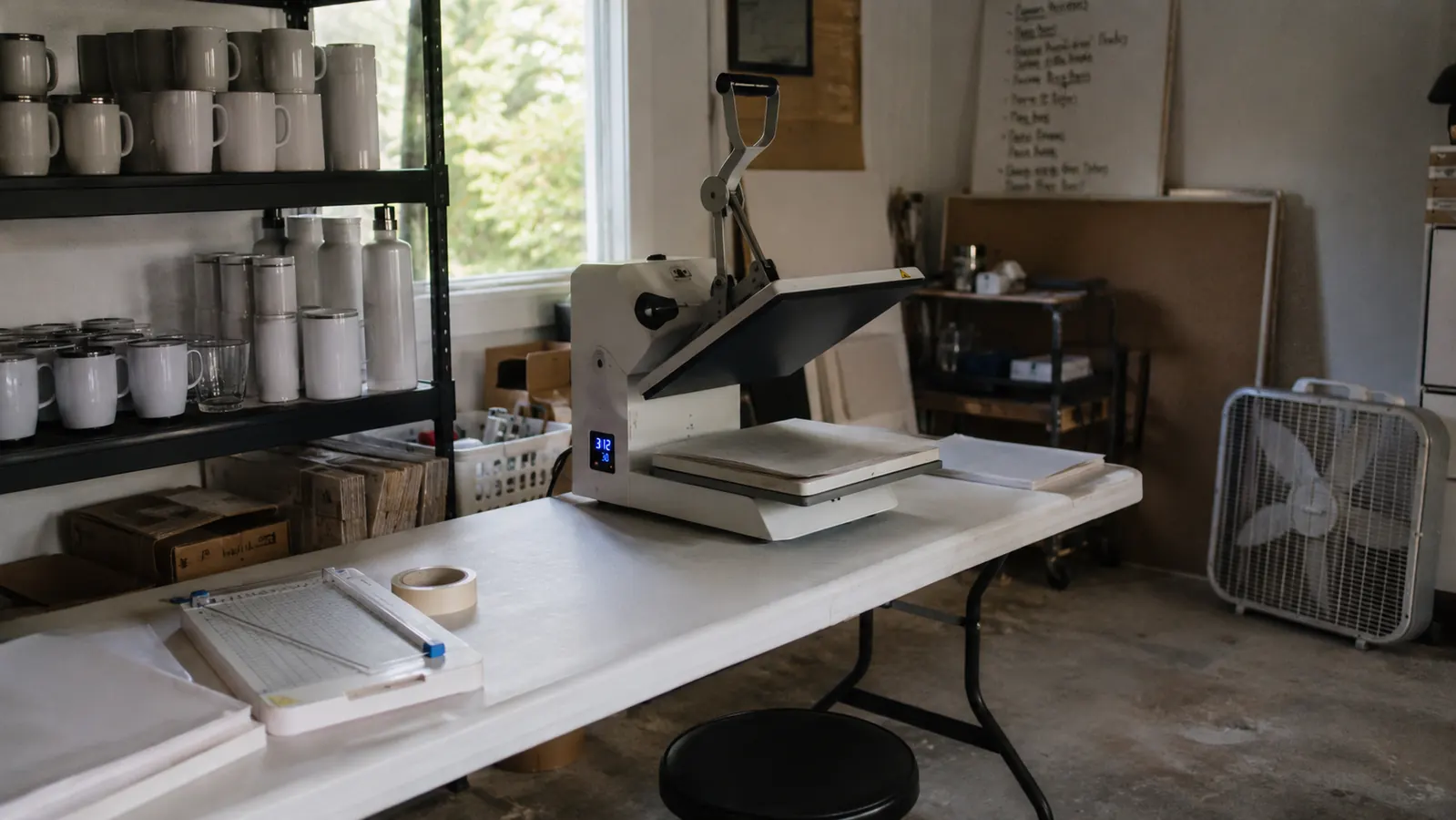
The machine itself weighs about nine and a half pounds and measures roughly 12.9 by 10.9 by 6.3 inches, so it does not swallow the table. I keep it at the end nearest the outlet, blanks stacked to my left, a towel to my right for finished pieces. In summer the garage gets hot and I run a box fan, but the press has never been the thing that made me quit for the day. It sits there, it does its one job, and it does not ask me for anything.
The Auto Feature Nobody Explains Properly
Here is the part that gets glossed over in most write-ups. The automatic part does not mean the machine thinks for you. It means the machine holds the heat pad closed against the tumbler at a consistent pressure while you step back and use your hands for something else. You still choose the temperature. You still decide when the piece is done. What you stop doing is standing there squeezing, which sounds minor until you have squeezed through a twenty-piece order.
The other half of that is the R button, and I want to be specific about it because it is the feature I use most. Pressing R halts the heating and releases the heat pad instantly. On a manual setup, releasing means loosening a strap or peeling back a wrap while the blank is still hot, and that is where most of my burned fingertips came from. Here it is one press and the pad lets go. I still wear a glove. I am not brave.
The temperature range runs from 210°F to 390°F, and the press is rated at 600 watts on 120 volts, so it plugs into the ordinary garage outlet I already had. I rarely push the top of that range, because most of what I press lives somewhere in the middle, but the range is there when a heavier blank needs it. The shell is ABS, which mostly means it does not feel like a workshop tool. It feels like an appliance, and I treat it like one.
What It Presses, and What It Will Not
The stated fit is tumblers from 2.9 inches to 3.2 inches in diameter, holding 10 to 30 ounces. That is a real range and it covers the standard straight and slightly tapered tumblers that school and church orders ask for. The manufacturer lists mugs, water bottles and glass drinkware as intended use too, so the tumbler work is not the only thing it handles. I have done glass drinkware with it and the press did not complain.
What it will not do is stretch. If you show up with a bottle wider than 3.2 inches across, or a tumbler that swells at the base past what the pad can wrap, you are not pressing it in this machine. I learned that with a batch of wide-bottomed bottles a customer brought in herself. They went home unpressed that day, and I learned to ask about diameter on the phone before I quote anything. If you take one thing from this review, take that one.
When those wide bottles showed up, I did what I should have done in the first place. I got a ruler out and measured straight across the base. They came in just under 3.5 inches, a quarter inch past what the pad will close around, and no amount of adjusting was going to change that. I have measured every blank that comes through the door since then and written the number on the end of the box in marker. It takes ten seconds and it has already saved me two awkward phone calls. My own 20 ounce straight tumblers, the ones I buy by the case, measure right at 3 inches and have never given the pad a moment of trouble.
Very slim tumblers are their own conversation. The pad wraps, but a narrow blank gives the paper less flat surface to sit against, and my first attempts showed every wrinkle in the sheet. That is a taping and paper problem more than a press problem, but it is the kind of thing you discover on your own dime if nobody mentions it first. Buy a couple of spare blanks in the size you plan to sell and practice on those before you touch a customer order.
The press is steady. My hands never were. That is the entire argument for buying one, and it is a good argument.
The Learning Curve Is Real
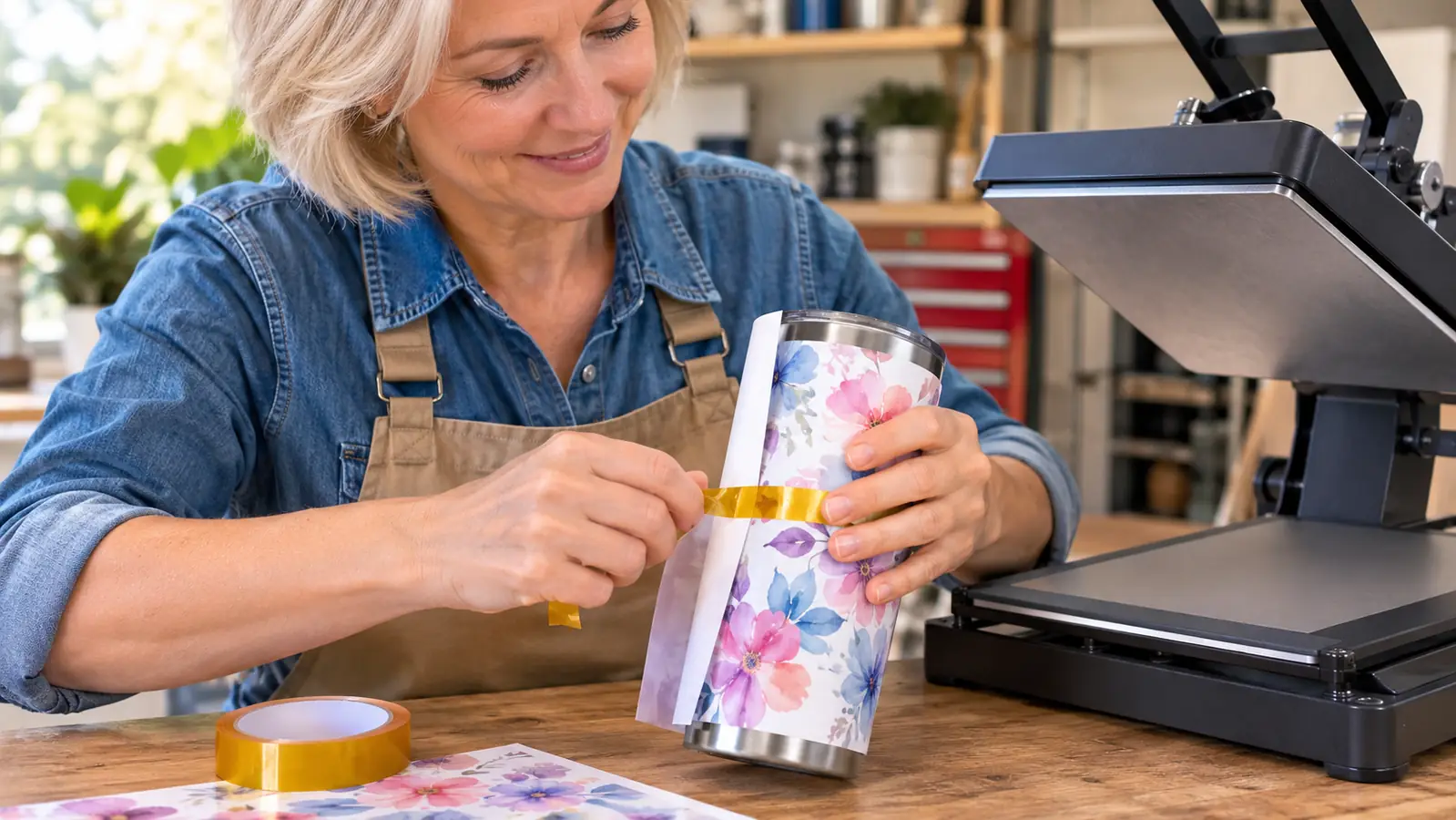
I want to be honest about the first week, because the honest review is the one you came for. The machine did not make me good at sublimation. It made me consistent, which is a different thing. My early tumblers had ghosting where the paper shifted a hair under the tape, and one came out with a faint seam where the wrap overlapped itself. None of that was the press misbehaving. It was me learning how much tension to use and where to put the tape.
The worst night was a Tuesday in October. I had six tumblers for a small business order due the next morning and I had already pressed three before I noticed the sheet had crept about an eighth of an inch on every one of them. Not enough to look wrong at a glance. Plenty wrong when the owner set three of them side by side on a counter. I stopped, pulled the rest, re-taped with the overlap at the back, and finished a little after eleven that night. The reprints cost me three blanks and two hours I had not planned on spending.
The fix was boring. I slowed down. I started wrapping the sheet and letting the tumbler sit for a minute before taping, so the paper had settled against the curve instead of springing back. I pressed a couple of blanks I had already ruined, just to feel the closure and the release without caring how they turned out. Two evenings of that and my hit rate went from maybe half to nearly all of them, and the difference was technique, not equipment.
If you are the sort of person who needs to be good at something on the first attempt, this will be a frustrating purchase, and that has nothing to do with HTVRONT. Any press rewards the person willing to waste a few blanks learning its habits. The advantage here is that the habits are simple and repeatable, so the curve flattens quickly. A machine with a fussy setup would have taken me a month to trust. This one took a weekend.
What You Need Besides The Machine
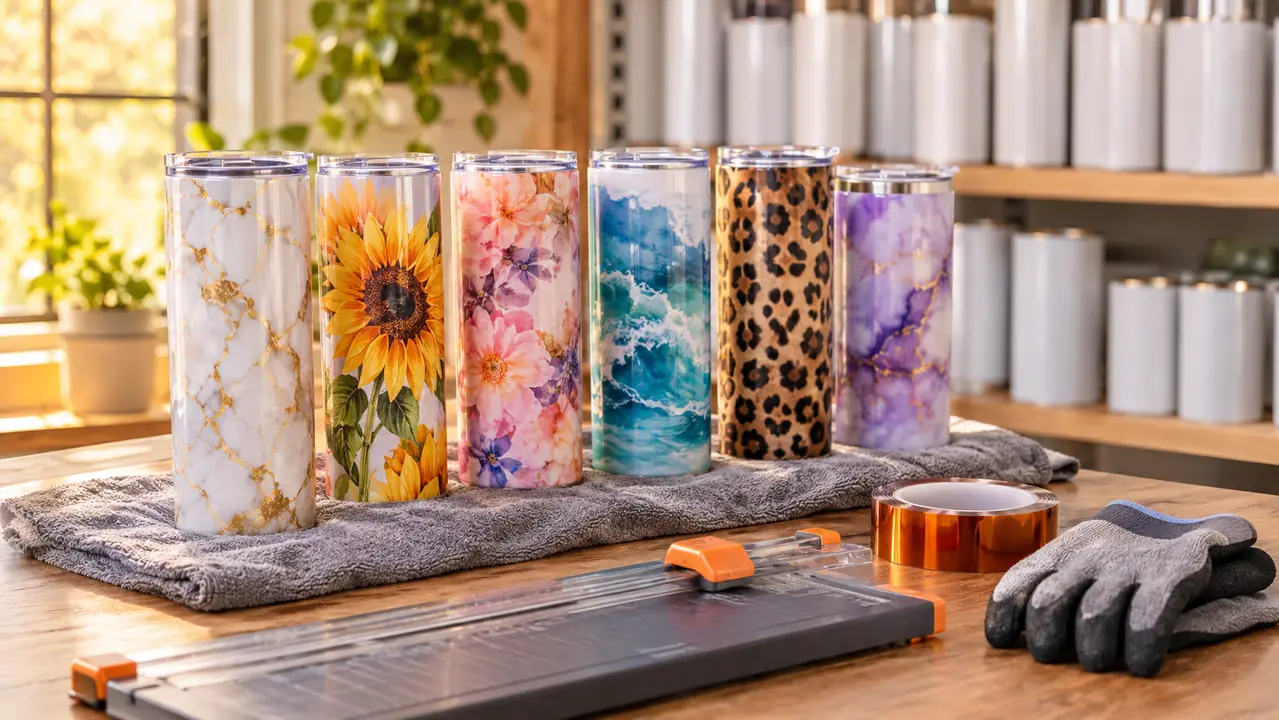
The press is only one piece of what this takes, and I do not think that gets said enough. Once the machine is on your table you still need blanks, sublimation paper, heat-resistant tape, a trimmer, gloves, and something to protect the table surface. You need a shelf too, because a box of thirty tumblers takes up more room than you expect it to. None of that is a reason to skip the press. It is a reason to plan the whole shelf before you plan the machine.
The tape was the item I underestimated. A roll of heat-resistant tape disappears faster than you would believe when you are taping a full wrap on every single piece, and there is nothing worse than being three tumblers into a batch with two inches left on the roll. I keep two rolls in the drawer now, and I do not open the second one until the first is finished, so there is always a spare underneath it. The trimmer matters as much. A dull blade drags the paper and leaves a ragged edge that shows up in the finished print, and a fresh blade costs far less than a ruined blank and a redone order.
There is a time cost that never appears in a listing either. A tumbler order is not one job, it is five small jobs in a row: design, print, wrap, press, cool and pack. The press removes the wrist pain from one of those steps. It does not remove the step. I still block out a whole evening for a twenty-piece order, and Gary still folds and bags on the busy weekends while I keep the press moving. The machine buys you hands, not hours.
What I'd Do Differently If I Started Over Today
I would ask about diameter before I ever quoted a drinkware order. That is the whole thing. Every frustrating moment I have had with this press traced back to a blank that was the wrong size or a paper that was the wrong weight, and both of those are questions you can ask on the phone in thirty seconds. The machine is honest about its range. The trouble comes when you are not.
I would also buy ten cheap blanks in my best-selling size and treat them as tuition. Press them badly on purpose. Wrap them wrong on purpose. Learn where the tape wants to go and how the paper behaves when it is cold in the garage versus warm. Two ruined tumblers taught me more than any video did, and the tuition cost me less than a single returned customer order would have.
What I Liked
- Automatically holds the heat pad closed on 10 to 30 ounce tumblers between 2.9 and 3.2 inches in diameter
- The R button halts heating and releases the heat pad instantly, so you are not peeling a hot wrap off by hand
- Consistent treatment from the first piece in a batch to the last
- 210°F to 390°F range covers ordinary sublimation work on drinkware
- About 9.5 pounds and roughly 12.9 by 10.9 by 6.3 inches, so it lives on a normal folding table
- Backed by a one year warranty
Where It Falls Short
- Bottles wider than 3.2 inches simply will not fit, and no technique fixes that
- It cannot rescue bad wrapping, cheap paper or sloppy taping
- You still load and unload every piece yourself
- 600 watts of heat in a garage in July does not make the garage cooler
- No help with design, sizing or paper choice, all of that stays with you
Who This Is For
This press is for the person already taking drinkware orders and tired of doing them by hand. If your busy week is six tumblers, this is more machine than you need and you will not get the value out of it. If your busy week is two dozen pieces and your hands ache at the end of it, this is the upgrade that changes your evening. The dividing line is not skill. It is volume and repetition.
It is also a sensible first press for someone who has decided to sell drinkware, because the size range covers the orders people actually place. School colors on a 20 ounce tumbler. A church logo on a mug. A reunion design on a water bottle. Those are the jobs, and this handles all of them without a separate machine for each shape. One press, one table, one outlet.
Who Should Skip It
Skip it if you want to press shirts, totes and hats. This is a drinkware machine, and it will not do flat garments. My shirt press still handles all of that and it is not going anywhere. Skip it too if the blanks available to you locally run wider than 3.2 inches, because no amount of practice fixes a fit problem. Ask the question before you buy, not after.
And skip it if you are hoping the machine will make the business. It will not. It removes one repetitive physical task from a job that still needs design decisions, customer conversations, careful packing and a great deal of patience. What it gives you is a batch that looks like a batch instead of a pile of near misses. That is worth a lot to me. It is not a business in a box, and HTVRONT does not claim otherwise.
If your hands are the bottleneck, this is the fix
The HTVRONT auto press holds the pad so you do not have to, from 210°F to 390°F, on tumblers from 10 to 30 ounces. Check the diameter range against your blanks first, then let the machine take the squeezing out of your next order.
Amazon Check Today's Price on Amazon →