
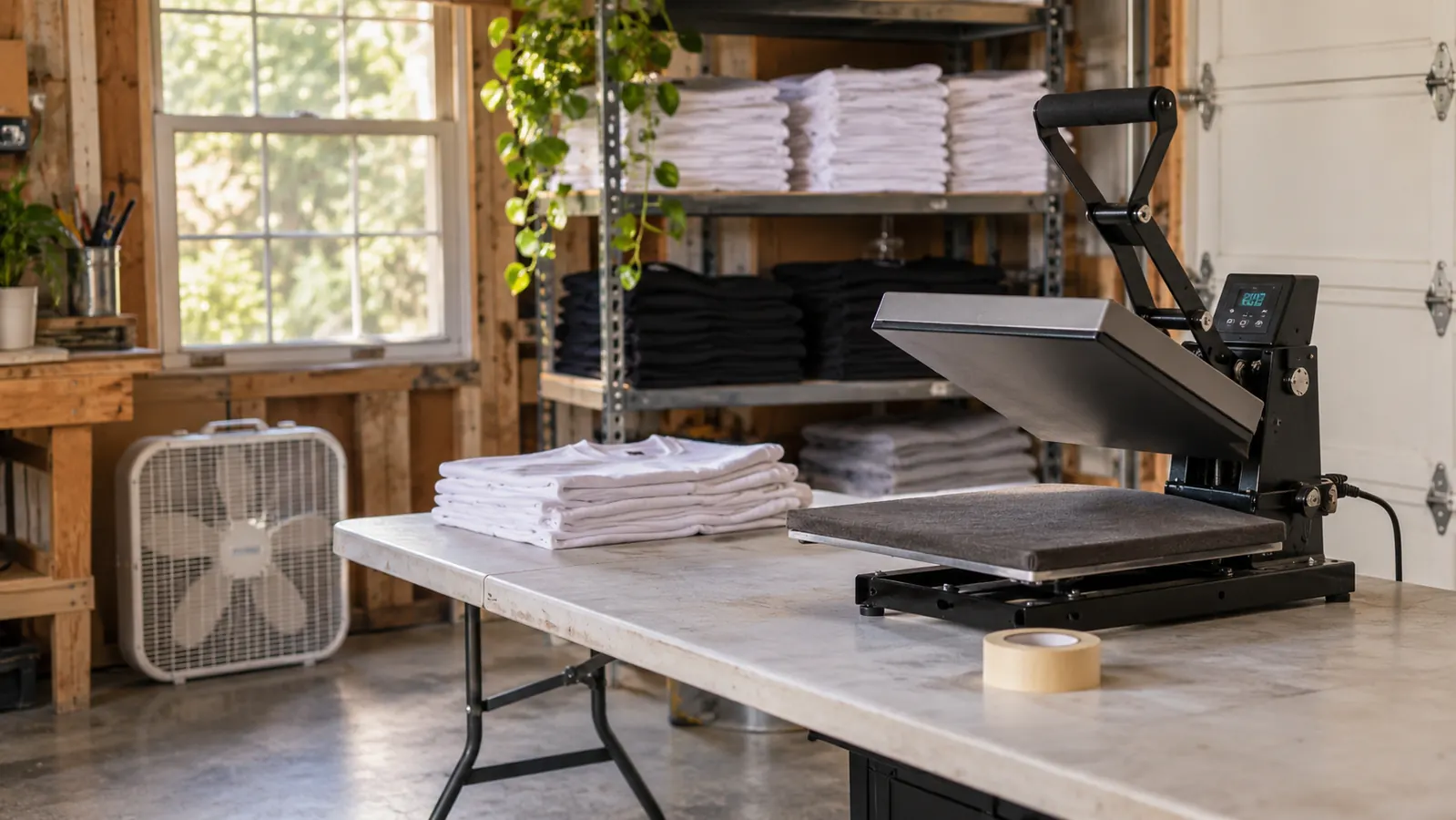
The Fancierstudio 15x15 heat press is the machine that shows up in every beginner thread, usually with a link and a question mark next to it. I bought mine about four years ago, back when I was pressing team shirts for my grandson's baseball league on a folding table in the garage. Nobody explained much to me. The listing explained less. What I know now came from a stack of ruined blanks, one tripped breaker, and a few hundred presses on the same machine.
This is the part nobody writes down. Not the specs, the part where you find out that a 15 by 15 platen does not solve every layout problem, that the temperature listing contradicts itself in two places, and that a three month warranty should change the order you do things in your first week. If you are deciding between starting here or saving up for something bigger, that is what this is for.
The Quick Verdict
A real 15 by 15 press at a hobby machine cost. The short warranty and the 1800 watt draw are the two things to plan around. Press scrap first, then press things you can sell.
Amazon Check Today's Price →A full adult front in one press, at a first press cost
The platen size is the whole argument for this machine. Check today's price and the current listing details before you decide, and read the warranty line while you are there.
Amazon Check Today's Price on Amazon →How I Have Actually Used Mine
The garage is a converted one car space with one long folding table, a shelf of blanks, and a box fan I run in July. My press has lived at the end of that table for four years and it has not moved. I press cotton and poly tees, tote bags, mouse pads, and rhinestone transfers for a cheer squad at the school where I used to work. On a busy weekend I might run two dozen pieces. On a slow month the press sits cold, and that is fine, because it is a simple machine and it does not care.
The work has been local the whole time. School teams, a church group, a family reunion, two small businesses that wanted staff shirts with their logo on the pocket. Word of mouth and a local Facebook group. No storefront, no second shop. I mention the volume because it matters for the honest verdict: this press suits my volume well, and I would feel different about it if I were running it eight hours a day.
Last October is a fair picture of a heavy stretch. The cheer squad wanted 60 pieces, the church youth group wanted 24 totes, and both landed inside the same two weeks. I pressed in the evenings after supper, about three hours a night, and I kept a spiral notebook on the shelf with the temperature and the time written down for each blank so I would not have to remember which poly blend wanted which setting. The Fancierstudio never quit on me that month. My back did. Sixty pieces at three hours a night is a solid week of evenings, and that is the honest pace of one press in a garage.
Gary helps me fold and bag on the weekends when an order runs long. He has also watched me swear at a misaligned sleeve more than once. The press itself has never been the thing that failed. My layout has failed. That is worth saying up front, because the machine gets blamed for a lot of mistakes that belong to the person running it.
The Platen Is the Whole Reason to Own It
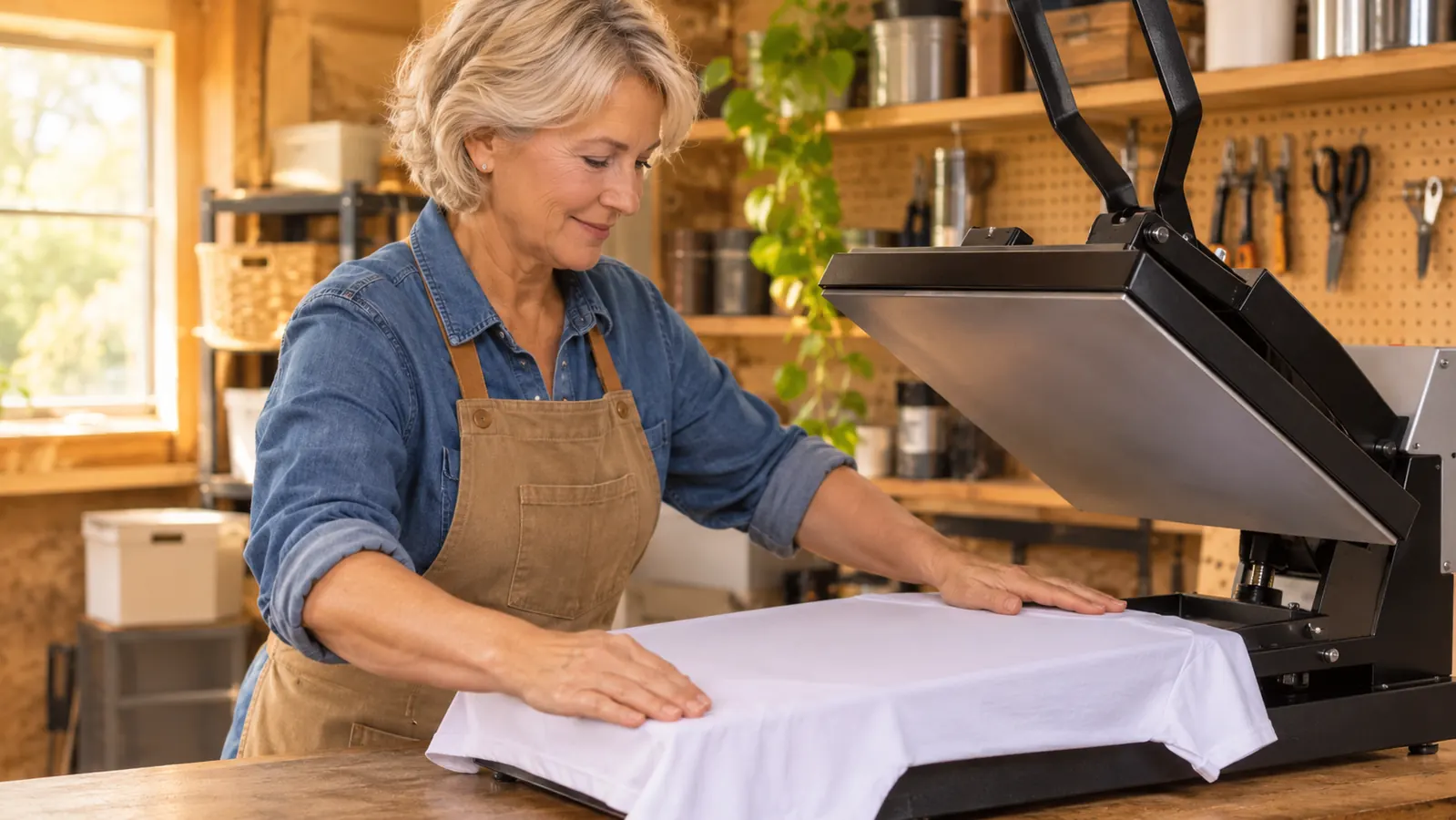
Fifteen by fifteen is the number that sold me. A full adult front print fits inside it in one press, and so does a full back on most mediums and larges. My old setup meant two presses and a visible seam line down the middle of a design. Once you have done that on a customer's shirt, you will pay for a bigger platen.
Here is the limit nobody mentions. On an extra large or a two XL, a full back print does not fit in a 15 by 15 window. You are either shrinking the design or doing it in two passes and hoping the second one lands where the first one ended. If your orders lean toward big and tall sizes, plan for that now. It is the most common reason people outgrow this press.
Let me put a number on it so you can check it against the sizes you actually get asked for. A standard full back print on an adult large runs about 12 inches wide by 14 inches tall, which sits inside a 15 by 15 window with an inch of margin on every side. An extra large back print is often 13 by 16, and that inch over the top is the entire problem. When one of those comes in now, I scale the design down to 14 inches tall rather than splitting it. It costs a little graphic impact and it costs me nothing in ruined blanks, which is the trade I will take every single time.
The other thing is placement. The lower platen is a fixed surface, and the shirt has to drape off it without a thick seam or a button placket doubling up under the heat. A tote bag with a heavy handle seam is the same problem. Those are the presses where you get a faint line you cannot iron out. Thread the garment on so the thick parts hang off the edge and you will save yourself a lot of blanks.
What the Controller Will and Will Not Do
The controller gives you electronic time and heat control, and the listing says it sets time precisely, with a range that runs to 999 seconds. Temperature control is where the listing gets muddled. The feature bullets claim a range up to 699 degrees, and the attributes list a 500 degree upper rating. Both cannot be right, and honestly it does not matter, because nothing you press wants to be anywhere near either number.
My working temperatures are 350 for most cotton tees, 385 for a heavier poly blend, and 300 for a sublimation blank I do not want to scorch. Fifteen to twenty seconds for a transfer, longer for a thick rhinestone sheet. Those are the numbers I actually use. I keep them on a strip of masking tape stuck to the edge of the table, because every job starts with setting the temperature and the time by hand.
I found those numbers the slow way. My first poly blend scorched at 400 and left a brown ghost of the transfer cooked into the shirt, which is a mistake you only make once because the shirt is unusable and you cannot sell it or give it away. I dropped to 385, shortened the press to fifteen seconds, and it came out clean. A cotton tee at 350 for eighteen seconds with a firm lean on the handle has been my default ever since. The Fancierstudio readout has matched a cheap infrared thermometer every time I have checked it, and that one check is worth doing in your first week so you know the number on the screen is the number on the platen.
What the readout does not tell you is the recovery after you open the press. The platen drops the moment it meets a cold shirt, and the number climbs back up while you are loading the next piece. If you press back to back without giving it a minute, your second shirt gets less heat than your first. Give it time to climb back to temperature. It is not a fast machine in that sense, and pretending otherwise is how you get transfers that peel in the wash.
1800 Watts, a Garage Circuit, and the Fan
The press draws 1800 watts at 110 volts, which works out to about sixteen amps. That is not a small load. A standard household circuit is fifteen amps, and a garage circuit is often twenty, shared with a light, a freezer, or a box fan. The first time mine tripped, I had the fan running and a shop light on the same line.
It tripped on a Saturday morning in my second week, halfway through a stack of twelve team shirts, and I stood there in the dark for a second before I worked out what had happened. The press, the fan, and the shop light were all drawing off the same garage line. I moved the fan to an outlet on the kitchen side of the wall and the problem went away for good. I also stopped using an extension cord. A long thin cord carrying that load gets warm at the plug, and warm at the plug is not something you want sitting next to a pile of fabric. If the press has to reach, use a heavy cord rated for the load and keep it short.
Fix that before it becomes a habit. Either move the press to a circuit with nothing else on it, or stop running the fan while you press. I unplug the fan now, press for an hour, then plug it back in and take a break. The garage gets warm in July and the press is a hot surface, so a break is not a hardship.
Warm up matters too. The readout will say the platen is at temperature well before the whole surface is evenly hot, especially from cold. I give it several minutes, then press a scrap of the same fabric I am about to use. That test press tells me three things at once: whether the heat is even across the platen, whether my pressure is right, and whether the transfer actually releases clean. Two minutes of scrap has saved me dozens of shirts.
A test press on scrap tells you more about your setup than any listing photo ever will. Two minutes of ruined fabric saves a dozen ruined shirts.
Sublimation and Rhinestones, Why So Many Beginners Land Here
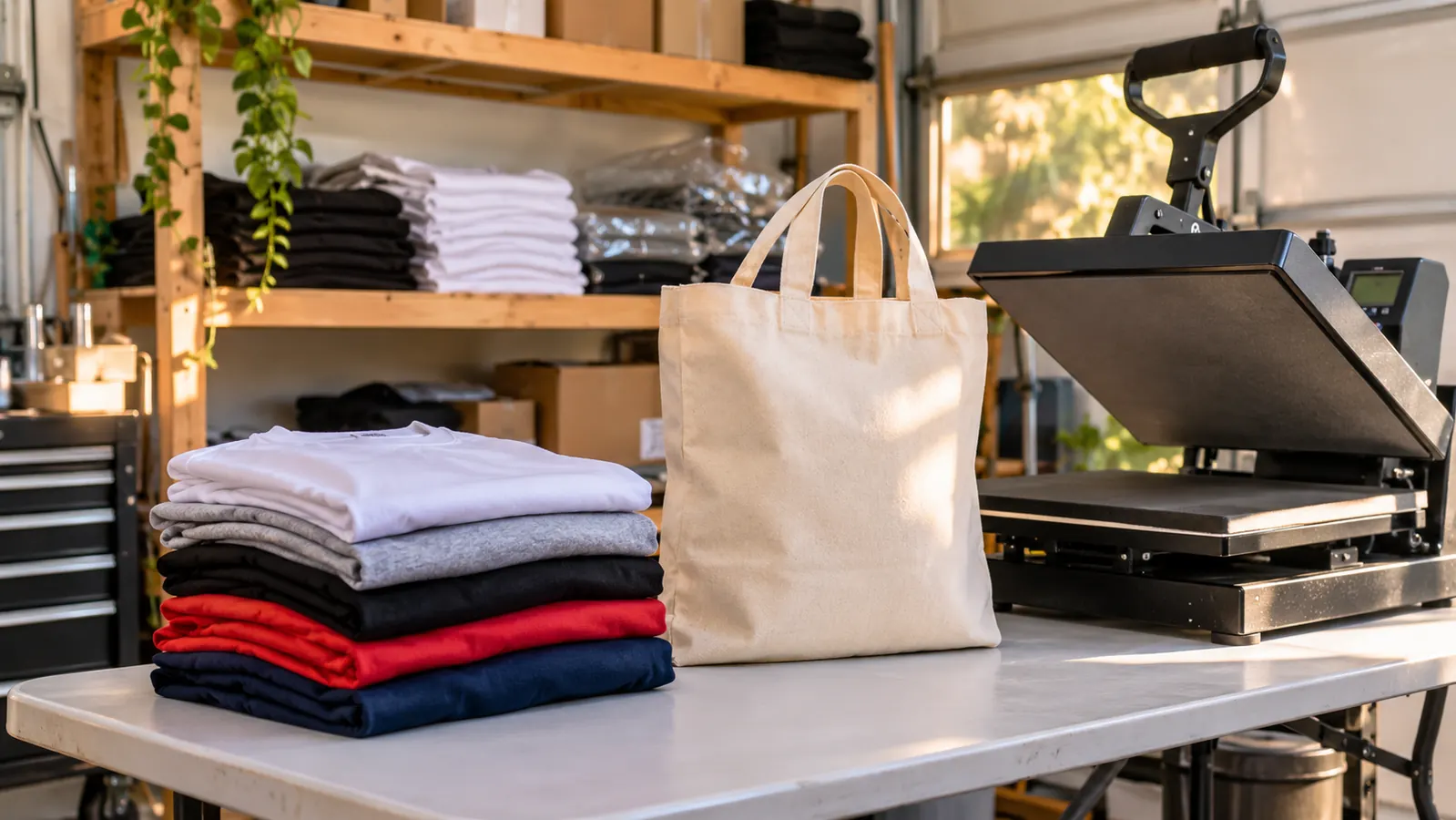
The platen has a Teflon coating and the box includes a 15 by 15 heat press sheet. For sublimation that matters, because you want a barrier between the platen and the paper and you want a surface that wipes clean. I do polyester totes and poly performance shirts this way. The 15 by 15 window means a full tote face goes down in one press, which is the difference between a clean sublimation and a double image.
Rhinestone transfers are the other reason people buy this size. A full front rhinestone design for a cheer squad is a sheet that fits the platen in one go, and one even press is what keeps the stones stuck. Two overlapping presses mean sore spots where the second press pushed against the first half. If you are doing rhinestones at all, buy the biggest platen you can house and fit in your budget.
The mouse pad and tote bag use cases on the listing are not filler, by the way. Those are flat, forgiving blanks with no seams and no placket, and they are exactly what I would hand a beginner for their first twenty presses. A canvas tote at 350 for twenty seconds, with a sheet of parchment over the transfer, is the least stressful press you can make on this machine.
The Three Month Warranty Should Change Your First Week
The warranty is three months. That is short, and I would rather say it plainly than skip over it. A machine at this cost does not come with a two year guarantee, and if you assume it does you will be disappointed in month seven.
What that means practically is you should run the press hard in week one. Unbox it, put it on a circuit with nothing else running, and press scrap until you have found the temperature and the time that work with your blanks. Press a few of everything you plan to sell. Listen to it. If the controller behaves oddly or the platen has a cold corner, that is when you want to find out, not in month five with an order due Friday.
The flip side is that there is not much to break. It is a heating element and a controller. If something does go wrong outside the warranty, you are looking at replacing a part or replacing the press, and you should know that going in. I have replaced nothing in four years. I also know people who have had the opposite experience. That is the honest range with any machine in this class.
What I Liked
- A 15 by 15 platen presses a full adult front in one pass
- 1800 watts gets to working temperature without a long wait
- Teflon coated platen and a 15 by 15 heat press sheet in the box
- Electronic temperature and time control with a clear readout
- Very little to go wrong: a heating element and a controller, nothing else
Where It Falls Short
- Three month warranty is short for a machine you plan to keep
- 1800 watts will crowd a shared garage or kitchen circuit
- The listing contradicts itself on the top temperature
- No full back print on extra large garments in a single press
- The frame takes up most of a folding table at 33 by 23 by 20 inches
Who This Is For
This press is for the person who has been pressing shirts with an iron or a small craft press and has hit the wall. You want a real platen, one press for a full front, and you want to spend a beginner amount to find out whether you actually like this work. It is also a good fit for school and church orders, family reunions, and small business logo shirts, which is most of what my own work has become.
It suits a dedicated space. A garage, a basement corner, a spare room with a solid table and a circuit that is not already full. You do not need much room, but you do need that much. The Fancierstudio has held up to four years of weekend work in my garage, and I would buy it again for the same job.
Who Should Skip It
Skip it if your orders lean toward all over prints or plus sizes, because the 15 by 15 window will fight you and you will be back shopping in a year. Skip it if you expect to run production volume every day, because a machine built for a beginner's pace will wear out faster at a professional's pace, and the three month warranty will not be there to catch you.
Also skip it if you cannot give it a circuit of its own, or if the only place you could put it is a kitchen counter in a small apartment. It takes the end of a folding table, it radiates heat, and an 1800 watt load in a kitchen competes with everything else on that line. Be honest with yourself about the space before you buy, because the machine is the cheap part of getting set up.
If you are starting from zero, this is the machine I would start on again
Fifteen by fifteen, 1800 watts, and a controller you set by hand for every job. Four years in my garage and it is still the press on my table. Check today's price and read the warranty line before you commit.
Amazon Check Today's Price on Amazon →